Case study
EthnoLingo
A language-learning app for Ibibio, Annang and Oron, and a pronunciation coach that hears tones off-the-shelf speech recognition can't, designed, built and run by one engineer.
- Role
- Sole engineer
- Year
- 2026
- Platform
- Android app · admin panel · website
- Stack
- React Native · Node.js · MongoDB · Redis · Python
- Live
- ethnolingo.net
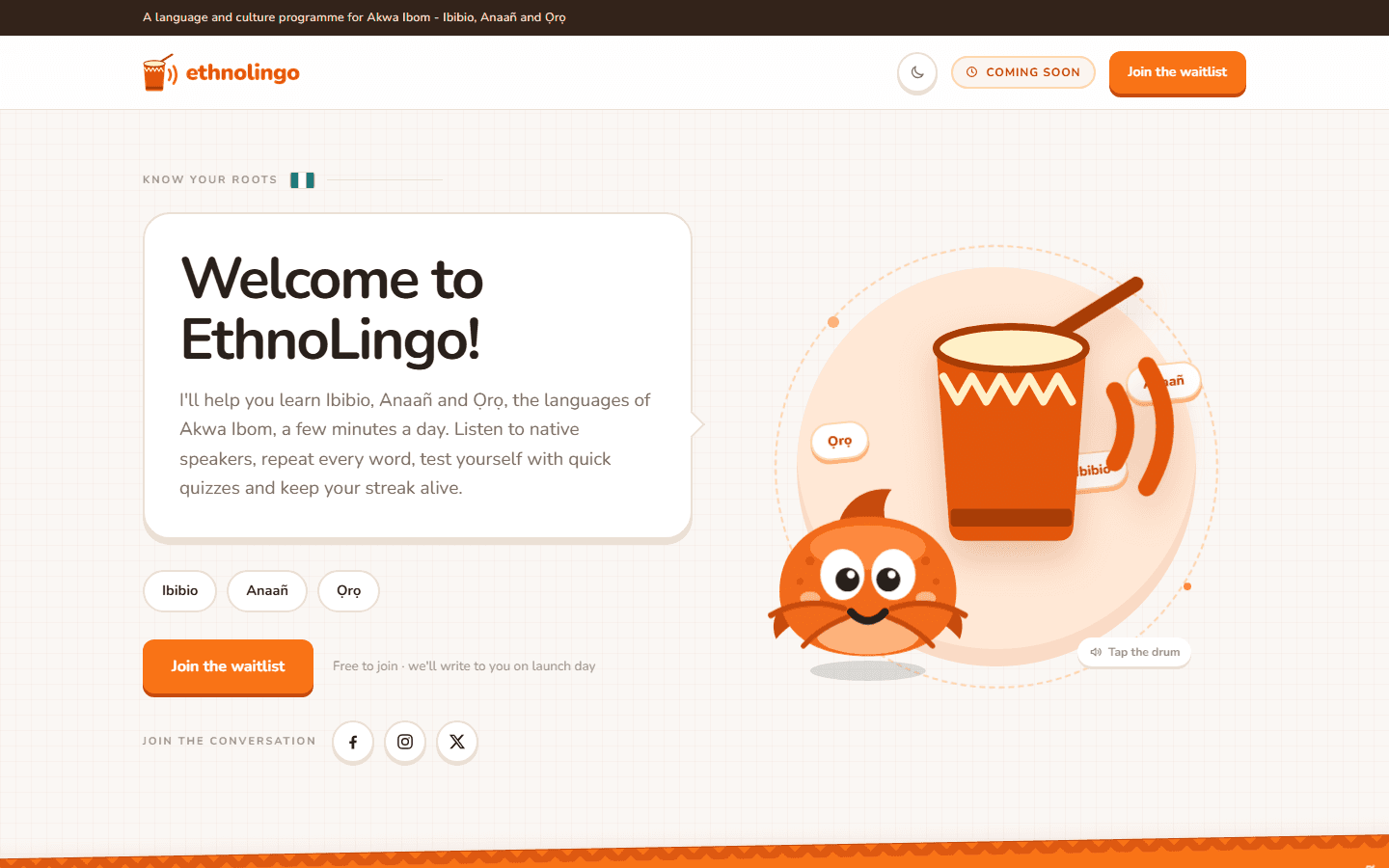
01 — The problem
Why it needed building.
Ibibio, Annang and Oron are spoken across Akwa Ibom, but the big language apps don't teach them. Many young people in Akwa Ibom, and many more in the diaspora, grow up understanding a few words but never learning to speak their parents' language. Each generation that loses it also loses the proverbs, songs, names and stories that only exist in it. EthnoLingo is my way of preserving that culture and tradition in a world that moves fast and forgets easily, a few minutes a day, on the phone people already carry.
The harder problem is speaking. These are tone languages, where pitch changes a word's meaning, and mainstream speech recognition such as Whisper doesn't support them at all. So an app that only showed words and translations would teach people to read the language, not to say it.
02 — Who it serves
One API, three front doors.
Learners
Use the Android app for lessons, quizzes, pronunciation practice, streaks and a leaderboard. It keeps working on a bad connection.
Staff
Use an admin panel to manage lessons and users and to watch a live dashboard. Every staff account has to set up two-factor sign-in, and the server checks each role's permissions.
Visitors
Find the project at ethnolingo.net and join the waitlist. The site uses the same API as the app.
03 — The product
Learning that brings people back.
- 01
Lessons & rounds
Each lesson is one word or phrase with a native speaker's recording. Every 10 lessons unlock a question round, and a round passes at 70%.
- 02
Pronunciation coach
Learners record themselves saying a word and get a score against the native recording. Three misses flag the word for more practice later.
- 03
Streaks that forgive
Streaks follow each learner's own time zone. Once a month, a learner can restore a streak that a single missed day broke.
- 04
Rewards
Learners earn XP, gems, badges and daily rewards. They spend gems on outfits for the app's mascot, and every award is logged.
- 05
Leaderboard
One all-time ranking by XP, served from a fast Redis copy and rebuilt from the permanent log if that copy is ever lost.
- 06
Ship without a store release
Most updates go out over the air through Expo and reach phones on their next launch. Only changes to native code need a new Play Store build.
04 — My role
Every layer, one engineer.
I designed and built all five parts: the React Native app, the Node.js API, the Next.js admin panel and website, and a Python speech-scoring service. I also deploy and run them on Railway and Vercel, with logs, metrics and traces in Grafana Cloud.
The heart of EthnoLingo is its native speakers. Every lesson is built on one of their recordings, and their voices are what learners hear, copy and practise against. The software only carries what they give it, and working with their recordings taught me to listen first and build second.
05 — The hard parts
Where the real work was.
Scoring speech no model understands
Because no model transcribes these languages, the scorer compares the learner's recording directly with the teacher's. A multilingual model turns both into sequences of speech sounds, and a weighted comparison treats a near-miss more gently than a wrong sound. The model can't hear tone, so pitch is compared on its own, giving a score that is 75% sounds and 25% tone. Even a native speaker's copy of the recording scores only about 97 against the original, so each word gets its own ceiling, measured from altered copies of its recording, and scores are scaled to that ceiling. An attempt has to be the right word before it can earn any score.
Results that beat their own upload
Scoring runs as a background job and the result streams back to the app as soon as it's ready. A short job can finish before the upload's own reply arrives, so the app starts listening before it uploads and falls back to polling if the stream misses the result. Every attempt carries its own ID, so an upload that's retried is never scored twice.
Teaching on a bad connection
The app shows the last data it fetched, downloads lesson audio ahead of time, saves a quiz in progress so it survives the app being closed, and queues finished lessons to send, in order, once it's back online. Audio fetched in the background is cleared out after 150 MB, but anything the learner chose to download is kept.
Staying up when a piece fails
MongoDB holds every permanent record, and Redis only ever holds copies and temporary data. If Redis goes down, the API keeps serving in a reduced mode. Rate limits fall back to each server's own counters, the leaderboard reads from the permanent XP log, and queued work runs straight away. If the speech service fails, only scoring is affected.
06 — Results
By the numbers.
- 3languages taught
- ~800active learners per server, load-tested
- 5services, one engineer
EthnoLingo is still in its early days. What's here is the foundation: the lessons, the pronunciation coach and the system that keeps it all running. There's much more to come in future versions, and I'm just getting started.